
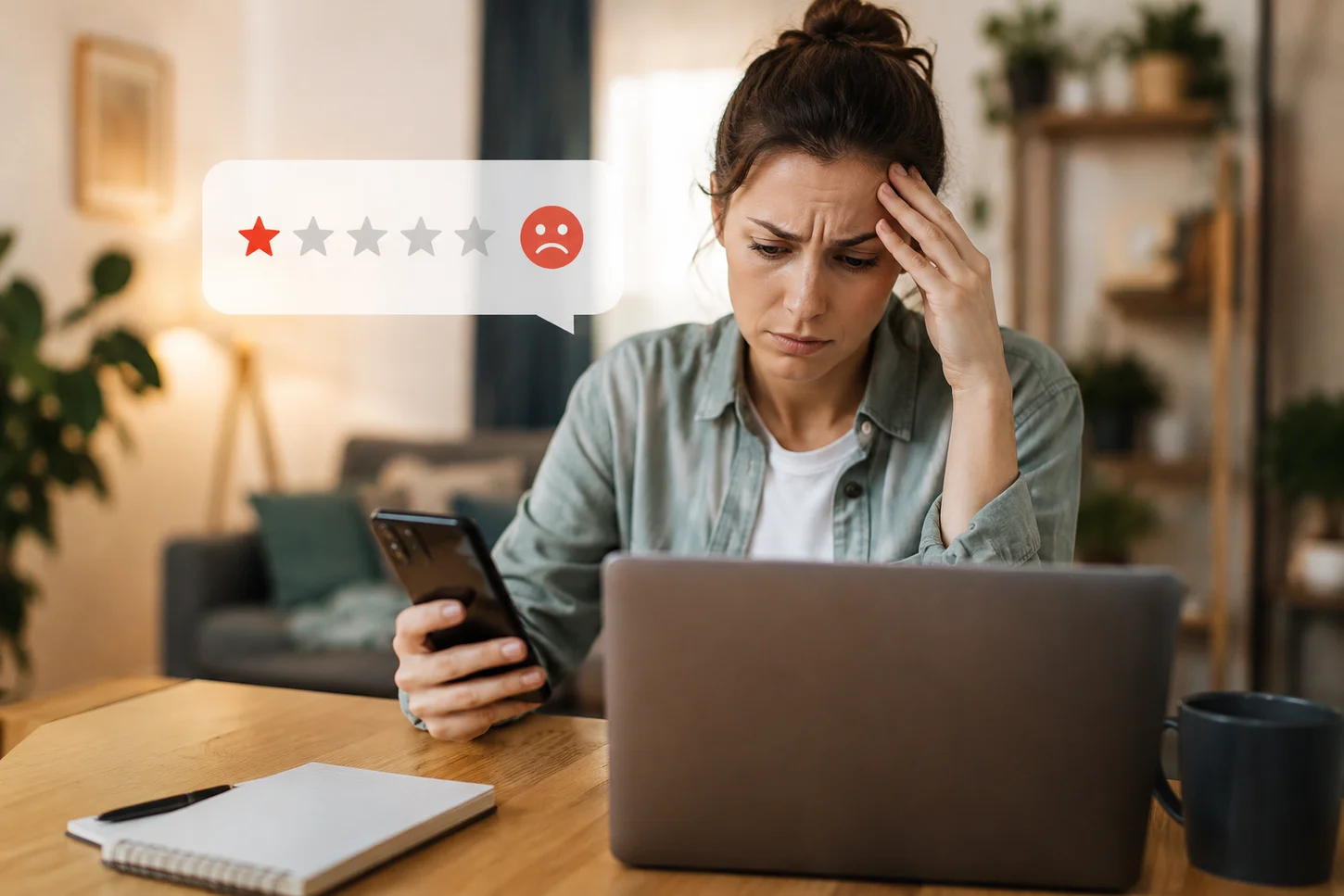
You work hard to create a great guest experience. You stock the kitchen, perfect the décor, write the welcome message, and make sure everything is exactly where it should be. Then one morning, you open Airbnb and find a two-star review waiting for you — and suddenly, none of that effort feels like enough.
A single bad Airbnb review stings personally. But the damage it does financially is where most hosts underestimate the risk. It’s not just about what one guest thought. It’s about the guests who see that review, pause, and choose another listing instead. It’s about the algorithm that quietly moves your listing down the page. It’s about the Superhost badge you lose, the nightly rate you feel pressured to lower, and the bookings that simply stop coming in.
This guide breaks down exactly what a bad Airbnb review costs you — in real numbers — and gives you a clear playbook for responding, recovering, and making sure it doesn’t happen again.
Why Airbnb Reviews Are More Than Just Feedback
How Airbnb’s Review System Actually Works
Airbnb’s review system is designed to build trust between strangers. After every stay, both the guest and the host have 14 days to leave a review. Once both parties submit — or the window closes — the reviews go live simultaneously. This double-blind structure is meant to encourage honesty on both sides.
Guests rate their stay across six categories:
| Category | What It Measures |
| Overall Experience | The stay as a whole |
| Cleanliness | Condition of the property on arrival |
| Accuracy | Whether the listing matched reality |
| Check-In | Ease of arrival and access |
| Communication | Host responsiveness throughout |
| Location | Proximity to what was promised |
| Value | Whether the stay was worth the price |
Your overall star rating is an average of these category scores across all reviews. But it’s not just a number for guests to read — it’s an algorithmic input that shapes where your listing appears in search, whether you qualify for Airbnb’s top badges, and how Airbnb’s platform treats your property at every level.
The Psychology Behind Guest Booking Decisions
When a guest lands on Airbnb and starts browsing, they’re making micro-decisions at every click. Your photos get them to open the listing. Your price keeps them reading. But your reviews are what convert a browser into a booking.
Research into online consumer behaviour consistently shows that negative reviews carry disproportionate psychological weight. A guest who sees a three-star complaint about cleanliness doesn’t just discount it — they amplify it in their mind. They picture it happening to them. And in a market where dozens of comparable listings exist, their decision to keep scrolling takes less than a second.
Guests booking vacation rentals are also making higher-stakes decisions than a restaurant meal or a product purchase. They’re committing days of their holiday and hundreds — sometimes thousands — of dollars to your property. That means they scrutinise reviews more carefully, weigh individual complaints more heavily, and tend to favour properties with consistently glowing feedback over those with a mixed record, even when the mixed listing is otherwise excellent.
Why Vacation Rental Owners Can’t Afford to Ignore a Single Bad Review
Here’s the uncomfortable truth: one bad review on a newer listing with fewer than 20 reviews can visibly shift your overall rating by several tenths of a point. And in a platform where 4.8 is the floor for Superhost status and 4.9 is where the algorithm starts rewarding you, a few tenths of a point is the difference between thriving and struggling.
Even on listings with a strong review history, a negative review sits at the top of your recent feedback — which is exactly where guests look first. Airbnb’s algorithm also weighs recent reviews more heavily than older ones, meaning a bad review today has a bigger impact on your search ranking than a great review from six months ago.
The moment you think of a bad review as just one person’s bad experience is the moment it starts costing you money.
The Real Dollar Cost of a Bad Airbnb Review
How a Rating Drop Hits Your Nightly Rate
Price confidence is directly tied to perceived quality. When your rating is sitting at 4.9 and the Guest Favourite badge is on your listing, you can price at — or above — the market rate for your area without losing bookings. When your rating drops to 4.6 or below, that confidence erodes. You’ll feel pressure to lower your nightly rate to stay competitive, and guests will still hesitate.
Industry data from the short-term rental market shows that listings rated 4.9 or higher command average daily rates 18–23% higher than comparable listings rated 4.5–4.7. That’s a significant pricing gap — not because the property itself changed, but because the review score changed what guests were willing to pay for it.
The Occupancy Effect — Fewer Clicks, Fewer Bookings
Beyond pricing, a rating drop affects your occupancy rate through two compounding mechanisms.
First, reduced search visibility. Airbnb’s algorithm deprioritises listings with sub-4.8 ratings in competitive markets. Fewer guests see your listing, which means fewer clicks regardless of how good your photos or description are.
Second, reduced conversion. Even guests who do find your listing are less likely to book when your rating is lower. A listing with a 4.6 rating converts at a meaningfully lower rate than one sitting at 4.9, even in the same location at the same price point. Guests have options — and they use them.
The result is a double hit: lower visibility driving less traffic, combined with lower conversion turning less of that traffic into bookings.
Running the Numbers: What One Negative Review Can Cost You Annually
Let’s put real numbers to this.
Imagine a property earning $150 per night with a 65% occupancy rate — a reasonable baseline for a well-reviewed listing in a mid-tier market. Annually, that’s:
$150 × 365 × 65% = $35,587/year
Now imagine a bad review drops your overall rating from 4.9 to 4.6. You lower your nightly rate to $130 to stay competitive, and your occupancy drops to 55% because you’re appearing lower in search results. Same property, one rating shift:
$130 × 365 × 55% = $26,117/year
That’s a difference of $9,470 per year — from a single bad review and its downstream effects. On higher-earning properties or in more competitive markets, that number scales significantly.
The Compounding Problem — When One Review Leads to More
Bad reviews don’t always arrive alone. A listing that’s been pushed down the search rankings tends to attract a different type of guest — one who booked largely on price rather than quality signals. Those guests sometimes have higher expectations relative to what they paid, which increases the risk of further complaints.
There’s also a confidence effect at play. Guests who see a recent negative review arrive at your property with their guard slightly up, looking for the thing they read about. A coffee mug left with a water ring becomes evidence. A slow Wi-Fi connection becomes a pattern. Small things that a positively primed guest would overlook become review-worthy grievances for a guest who arrived already uncertain.
The longer a bad review sits at the top of your profile without being pushed down by strong new reviews, the more damage it continues to do.
How Bad Reviews Hurt Your Search Ranking on Airbnb
The 4.8 and 4.9 Thresholds Explained
Airbnb’s algorithm doesn’t treat all ratings equally. There are two key thresholds that determine how your listing is positioned in search results:
- 4.8 — The minimum rating required for Superhost status. Listings that maintain 4.8 and above also receive a baseline level of algorithm preference in search placement.
- 4.9 — The threshold that unlocks Guest Favourite eligibility and positions your listing in the top tier of Airbnb’s search results. In 2025, industry analysts tracking the Guest Favourite badge found that holders typically sit around 4.9 or above on their overall rating.
The gap between 4.7 and 4.9 isn’t cosmetic. In competitive markets, that difference determines whether you appear on page one or page three of search results — and most guests never make it to page three.
Guest Favourite vs. Superhost — What You Stand to Lose
Airbnb currently operates two primary trust and quality designations:
| Badge | Minimum Requirements | Ranking Impact |
| Superhost | 4.8+ rating, 90%+ response rate, <1% cancellation rate, 10+ stays/year | Moderate visibility boost; filter advantage |
| Guest Favourite | ~4.9+ rating, near-perfect sub-scores, at least 5 reviews | Significant ranking priority; higher CTR from gold heart badge |
As of 2025, the Guest Favourite badge has become the platform’s most powerful visibility signal. Short-term rental managers and industry analysts who track listing performance consistently observe that Guest Favourite listings receive disproportionate placement in search results — with many reporting it as the single highest-impact ranking factor currently available to hosts. Losing eligibility for that badge because of a rating drop is one of the more expensive consequences of a bad review that hosts don’t always connect to their booking performance.
How Category Sub-Scores (Cleanliness, Accuracy, Check-In) Can Sink You Faster
The overall rating is what guests see at a glance, but Airbnb’s algorithm is widely observed to treat individual category scores as significant ranking inputs in their own right. Hosts and short-term rental analysts who track listing performance consistently report that sub-scores — particularly cleanliness, accuracy, and check-in — appear to carry meaningful independent weight beyond the overall star rating.
What this means in practice: a guest who gives you four stars overall but three stars on cleanliness can do real damage to your search position even without tanking your average. A single cleanliness complaint in the sub-scores has been reported to noticeably demote listings in competitive search queries — which is why hosts sometimes see a ranking drop that doesn’t fully reflect in the overall star average.
This is why hosts who receive feedback about specific issues — a bathroom that wasn’t deep-cleaned, an oven left with grease, a bed that smelled slightly musty — need to take those sub-score complaints as seriously as overall rating drops.
The Knock-On Effect on Click-Through Rate and Conversion
Your listing’s position in search results determines how many people see it. Your click-through rate (CTR) determines how many of those people open your listing. Your conversion rate determines how many of those who open it actually book.
A bad review affects all three.
Lower rating → lower search position → fewer impressions → lower CTR. And for guests who do click, the presence of a recent negative review lowers your conversion rate directly. Each of these reductions compounds the others, creating a booking shortfall that’s larger than any single metric suggests.
Beyond Revenue — The Hidden Costs Most Hosts Overlook
Loss of Superhost Status and What It Really Means for Visibility
Superhost status is evaluated quarterly. If a bad review drops your rating below 4.8 before the next assessment, you lose the badge — and with it, a layer of search visibility that’s easy to underestimate until it’s gone.
Superhosts appear with priority in Airbnb’s search filter system. Guests who tick the “Superhost” filter see only a subset of listings, and yours won’t be among them. In markets where this filter is commonly used, losing Superhost status can meaningfully reduce the number of guests who even have the option of finding your property.
Requalifying requires sustaining a 4.8 or higher rating across an entire quarter — which means the badge loss can last anywhere from a few weeks to several months depending on when the review hits relative to the assessment cycle.
The Risk of Listing Suspension After Repeated Low Ratings
Airbnb has the right to suspend or delist listings that receive consistently low ratings. While a single bad review won’t trigger this, a pattern of ratings at 4.6 or below raises flags in Airbnb’s system and can prompt a warning — or in more serious cases, a suspension — particularly if the low ratings are accompanied by host policy violations or unresolved guest disputes.
A listing suspension doesn’t just cost you future bookings. It resets your review momentum, disrupts any upcoming confirmed bookings, and can take weeks to resolve. The reputational damage within the Airbnb ecosystem can also be difficult to undo.
Psychological Toll on Hosts and Decision Fatigue
The financial costs are real, but so is the emotional cost of managing a bad review. For many hosts — especially those who take real pride in their properties and guest experience — a negative review triggers a genuine stress response. The impulse to respond immediately, to defend every point, to message the guest, or to seek review removal can consume hours of energy and lead to decisions that make the situation worse.
Decision fatigue after a bad review also leads hosts to make reactive, poorly-timed changes: dropping prices too aggressively, overhauling a listing description that didn’t need changing, or contacting guests to ask for updated reviews in ways that violate Airbnb’s policies. These responses can compound the original problem.
How a Poor Reputation Spills Over to Other Booking Platforms
Most hosts list their properties across multiple platforms — Vrbo, Booking.com, direct booking sites. A damaged Airbnb reputation doesn’t stay contained to Airbnb. Prospective guests increasingly research properties across platforms before booking. A negative review pattern on Airbnb can make guests on other platforms less confident in booking through those channels as well — particularly when they cross-reference the property name or address.
The cumulative reputational damage from a bad review spiral is wider than most hosts account for when they first receive negative feedback.
The Most Common Causes of Bad Airbnb Reviews
Understanding why guests leave bad reviews is the most direct path to preventing them. The majority of negative feedback clusters around a handful of recurring issues.
Cleanliness Complaints
Cleanliness is the single most common trigger for negative Airbnb reviews. Guests arrive at a vacation rental with high expectations around hygiene — often higher than they’d have for a hotel, because they’re paying for an exclusive use of the space. A missed spot in the bathroom, dust on a ceiling fan, pet hair on a sofa, or a kitchen that wasn’t properly wiped down can overshadow an otherwise excellent property.
Cleanliness is also one of the most emotionally charged complaints. It signals to a guest that they weren’t respected — that the host didn’t prepare the space properly for their arrival. That emotional dimension is why cleanliness complaints tend to generate lower scores than almost any other issue.
Listing Inaccuracies and Mismatched Expectations
The second most common source of bad reviews is a gap between what the listing promised and what the guest experienced. This includes:
- Photos that were taken before a renovation changed the décor
- A description that said “sleeps 6 comfortably” when the sixth bed is a pull-out sofa in a hallway
- Amenities listed that are broken, unavailable, or require the host to be contacted to access
- A location described as “5 minutes from the beach” that’s actually a 15-minute drive
Guests who arrive with accurate expectations almost never leave bad reviews for limitations they knew about in advance. The issue is almost always the gap — the difference between what was sold and what was delivered.
Unanswered Guest Questions During the Stay
Guests run into questions during every stay. How does the washing machine work? What’s the trash collection day? Is the fireplace safe to use? Where are extra blankets? When these questions go unanswered — or are answered slowly — frustration builds. A guest who spent 20 minutes trying to figure out how to work the TV or who couldn’t get Wi-Fi connected because they didn’t have the password readily accessible is a guest who’s already composing their review in their head.
Many of these questions are predictable. Hosts who proactively address them — through in-property information, welcome guides, or a digital concierge — eliminate the friction before it becomes a complaint.
Check-In Confusion and Arrival Friction
Check-in is the first physical interaction a guest has with your property. If it goes smoothly, guests begin their stay relaxed and positively primed. If it doesn’t — if the lockbox code doesn’t work, if the instructions were buried in a long email they can’t find, if they’re standing in the dark at 10 pm trying to figure out how to get inside — the entire stay starts on the wrong foot.
Arrival friction is particularly damaging because it colours everything that follows. A guest who had a frustrating check-in is more likely to notice and comment on every small imperfection during the rest of their stay. It sets a negative baseline that’s hard to reverse.
Noise, Maintenance, and Amenity Failures
Unexpected noise — from neighbours, nearby construction, HVAC systems, or within the property itself — generates reviews that hosts feel powerless about. Maintenance failures (a broken shower, a leaking tap, an appliance that doesn’t work) and unavailable amenities (a pool that’s closed, a BBQ that’s out of gas, a TV that’s not set up for the streaming services advertised) round out the most common complaint categories.
Some of these issues are genuinely unavoidable. How the host responds — both during the stay and in the review response — determines how much damage they ultimately do.
How to Respond to a Bad Airbnb Review the Right Way
A well-crafted response to a negative review doesn’t just address the guest who left it. It speaks to every future guest who reads it. Done correctly, a response can actually strengthen your listing’s trustworthiness rather than diminish it.
The 48-Hour Rule — Why Timing Matters
When a bad review lands, the instinct is to respond immediately. Resist it.
The 48-hour window after receiving a negative review is when most hosts make their worst decisions. They’re emotional, defensive, and inclined to argue points rather than demonstrate professionalism. A response written in that window often makes things worse — for the guest reading it, for future guests evaluating the exchange, and for the host’s own standing on the platform.
Airbnb gives hosts 30 days to publicly respond to any review. Use some of that window. Draft your response, step away, revisit it with fresh eyes, and publish only when you’re confident the tone is calm, constructive, and professional.
The 4-Part Response Framework Every Host Needs
Effective responses to negative Airbnb reviews follow a consistent structure:
- Acknowledge — Thank the guest for their feedback without being defensive or sycophantic. A simple “Thank you for taking the time to share your thoughts” is sufficient.
- Empathise — Where the complaint is fair, acknowledge the impact it had on their experience. Guests and future readers respond well to hosts who can admit when something wasn’t right.
- Address — Respond to the specific concern. If it’s a cleanliness issue, explain what steps have been taken. If it’s an inaccuracy in the listing, note that the listing has been updated. Be specific without being lengthy.
- Reassure — Close with a forward-looking statement about the standard of experience you aim to deliver. This is your message to future guests, not to the reviewer.
Keep the total response under 150 words. A long, detailed defence reads as defensiveness. A short, composed reply reads as professionalism.
What to Say (and What Never to Say) in a Public Reply
Do say:
- Acknowledgements of specific feedback that was fair
- Brief descriptions of improvements you’ve made since the stay
- A calm, professional reassurance that this doesn’t reflect the standard you hold for your property
Never say:
- Anything that questions the guest’s honesty or accuracy of their account
- Details about the guest’s behaviour or issues during the stay
- Aggressive or sarcastic language in any form
- An overly long justification of every point in the review
- A request for the guest to change or remove their review (this violates Airbnb’s policies and looks desperate to future readers)
For more guidance on how to handle a bad Airbnb review, Airbnb’s own resource centre has a useful framework directly from the platform.
When and How to Request a Review Removal from Airbnb
Most bad reviews cannot be removed. Airbnb’s review removal policy is narrow and deliberately so — the platform’s authentic and trustworthy reviews policy is a core part of what makes the system credible to guests.
That said, removal is possible in specific circumstances:
- The review is retaliatory — the guest left a bad review directly in response to a host policy enforcement or a report you made about them during or after the stay, and you have the message thread to evidence it
- The review is irrelevant — it discusses something entirely outside the scope of the guest’s stay (a third party’s actions, neighbourhood events, or circumstances completely outside your control that the listing never referenced)
- The review involves extortion — the guest requested money, a refund, or favours in exchange for a positive review (document everything in the message thread before raising a dispute)
- The review violates Airbnb’s content policy — it contains discriminatory language, threats, or personal attacks
One important clarification: Airbnb does not mediate factual disputes. If a guest wrote something you believe is factually untrue, that alone is not grounds for removal. Airbnb’s policy explicitly states they do not adjudicate on the truthfulness of a review’s content. Disputing a review on the basis that a guest “lied” will almost always result in a rejected claim — so don’t waste one of your two dispute attempts on it.
As of 2024–2025, Airbnb routes most dispute requests through automated triage and allows hosts only two dispute attempts per review. Don’t waste those attempts on complaints that are subjective or borderline — focus only on clear policy violations.
For details on responding to a review on Airbnb, Airbnb’s help centre walks through the process step by step.
Using a Bad Review to Build Future Guest Trust
The counterintuitive reality is that a listing with 98 five-star reviews and one thoughtfully responded-to three-star review often performs better than a listing with 98 five-star reviews and nothing else. The imperfection — and the professional response to it — signals authenticity. Guests know that perfect records can be manufactured. A host who handled a complaint gracefully is a host they feel they can trust.
Your response to a bad review is, in effect, a piece of marketing. Write it that way.
How to Recover Your Listing After a Negative Review
Recovery is an active process. Waiting for the bad review to age out without taking deliberate steps means slower recovery, extended revenue loss, and continued ranking suppression. Here’s how to accelerate the return.
Prioritise Getting New 5-Star Reviews Fast
The fastest path back is volume. A three-star review among 80 total reviews is a footnote. A three-star review among eight total reviews is a headline.
Airbnb data suggests that roughly 70–75% of guests leave a review when prompted effectively. Most hosts leave this on autopilot. During the recovery phase, pay deliberate attention to the post-stay communication sequence. A personalised, timely message sent within 24 hours of checkout — thanking the guest genuinely and mentioning that an honest review means a lot — meaningfully increases the percentage of guests who leave feedback.
Don’t ask for five stars explicitly. Ask for an honest review. Guests who had a good stay and are asked directly are highly likely to leave positive feedback, and the authenticity of the request makes them more likely to respond.
Temporarily Adjust Pricing to Rebuild Occupancy
A temporary, strategic price reduction during the recovery phase serves two purposes: it increases the number of bookings coming in (and therefore the number of opportunities to earn new reviews), and it sends a positive signal to the algorithm by improving your booking conversion rate.
The key word is temporary. A 10–15% reduction for four to six weeks — enough to fill the calendar and generate momentum — is more effective than a prolonged discount that trains guests to expect a lower price point for your property.
Once your rating has recovered and your occupancy is restored, return pricing to the market rate. The recovery discount should be a tactical move, not a permanent adjustment.
Update Your Listing to Reflect Any Improvements Made
If the negative review identified a real issue — a broken appliance, an inaccurate description, a cleanliness standard that wasn’t being met — fix it. Then update your listing to reflect the fix.
This matters for two reasons. It closes the expectation gap that caused the complaint in the first place. And it gives future guests a signal that you’re a responsive, attentive host. A listing that mentions “recently upgraded linens” or “WiFi just upgraded to fibre in March” communicates active management — which is exactly what guests want to see.
Boost Activity Signals the Algorithm Rewards (Calendar, Photos, Availability)
Airbnb’s algorithm rewards listings that show signs of active management. During the recovery period, treat every available lever as an opportunity to send a positive signal:
- Update your calendar — even small adjustments communicate active management
- Refresh at least one photo — new visual content signals an engaged host
- Expand availability windows — reducing minimum stay lengths temporarily increases the number of bookable dates and gives the algorithm more opportunities to surface your listing
- Enable Instant Book if you haven’t already — Airbnb consistently rewards Instant Book listings with ranking preference, and the friction reduction leads to higher conversion rates
These aren’t dramatic changes. But together they send a consistent signal that your listing is actively managed and ready for guests — which is exactly what the algorithm is looking for.
Reach the Guest Favourite Threshold — A Step-by-Step Approach
The Guest Favourite badge is the most powerful visibility tool currently available to Airbnb hosts. Here’s how to work toward it systematically after a rating dip:
| Step | Action | Timeline |
| 1 | Respond professionally to the bad review | Within 72 hours |
| 2 | Fix the specific issue raised | Before next booking |
| 3 | Implement proactive guest communication | Immediately |
| 4 | Prioritise 5-star review generation | Ongoing |
| 5 | Return to 4.9+ overall rating | 4–8 weeks (varies by review volume) |
| 6 | Maintain near-perfect sub-scores (especially cleanliness and check-in) | Ongoing |
| 7 | Reassess Guest Favourite eligibility | After 5+ new 5-star reviews |
How to Prevent Bad Reviews Before They Happen
The most effective review strategy is prevention. Most bad Airbnb reviews share a common root: a gap between what the guest expected and what they experienced. Closing that gap is almost always within the host’s control.
Set Accurate Expectations in Your Listing From Day One
Your listing description isn’t just a sales pitch — it’s a contract with your guests. The more accurately it reflects the reality of your property, the fewer disappointed guests you’ll receive.
Review your listing with fresh eyes. If your property is on a busy street, say so. If the bedroom that sleeps four has two bunk beds in a small room, show that in the photos. If the outdoor space is a Juliet balcony rather than a garden, be clear about that. Guests who arrive knowing exactly what to expect are almost never the guests who leave bad reviews — because there’s no gap for disappointment to fill.
Counterintuitively, accurate disclosures of limitations actually improve booking conversion in the long run. The guests who book despite knowing about a limitation are self-selecting as the right fit for your property. They’re less likely to be disappointed, more likely to have a great stay, and more likely to leave a five-star review.
Build a Pre-Arrival Communication Routine That Eliminates Confusion
The 48 hours before check-in are when guest anxiety peaks. They’re wondering if they have the right address, how the lockbox works, where to park, and what to do if something goes wrong. A host who addresses all of this proactively — through a well-structured pre-arrival message — eliminates the anxiety before it has a chance to build.
A strong pre-arrival message includes:
- Confirmed check-in time and exact address
- Lockbox or key collection instructions
- Parking details
- Wi-Fi name and password
- A brief note about what’s available in the property (coffee, basic supplies, etc.)
- A contact method for urgent issues
- A genuine welcome note
Keep it concise and easy to scan. Guests on arrival don’t read walls of text — they need quick-reference information in a format they can use while standing at your front door.
Use In-Property Tools to Answer Guest Questions Without Being Present
Even the best pre-arrival message doesn’t cover everything. Guests will have questions during their stay — about the appliances, the local area, the checkout process, the house rules. The question is whether those questions reach you as a message at 11 pm, or whether they’re answered instantly without the guest needing to contact you at all.
In-property information solutions — whether a printed guide, a digital binder, or a purpose-built in-property tool — close this gap by putting the answers exactly where the guests are: in the property, visible and accessible, without any searching required.
Properties equipped with in-property information tools consistently report fewer guest inquiries, fewer complaints about unanswered questions, and higher scores in the communication and check-in categories — precisely because the information is available without the host being present.
The Role of a Digital Guidebook in Reducing Guest Friction
A digital guidebook does more than list the Wi-Fi password and checkout time. When done well, it becomes the guest’s primary resource for everything they need during their stay — appliance instructions, local recommendations, house rules, emergency contacts, maps to nearby attractions, and personalised welcome details that make a guest feel genuinely looked after rather than processed.
The difference between a guest who knows where everything is and a guest who doesn’t is almost always the quality of in-property information. Friction — even small friction — accumulates over the course of a stay and surfaces in reviews. Removing it through a well-structured digital guidebook is one of the highest-leverage investments a host can make in their review score.
A digital concierge for reducing guest friction takes this concept further by putting the guidebook on the wall — accessible from the moment a guest walks in, without requiring them to find an email, download an app, or remember a URL.
Proactive Check-Ins During the Stay — Catching Issues Before They Become Reviews
A brief, genuine check-in message sent after the first night of a stay is one of the most underused tools in a host’s repertoire. Something as simple as “Hope you’ve settled in well — let us know if anything needs attention” does two things: it gives a guest with a minor complaint a low-stakes way to raise it directly with you, and it signals that you’re an attentive host who cares about the experience.
Guests who raise an issue mid-stay and have it resolved promptly almost never leave a bad review about it. The issue becomes a positive story — “the host fixed it immediately” — rather than a complaint. Guests who never get the chance to raise an issue because no one checked in are the ones who process it through the review form.
Tools and Systems That Protect Your Airbnb Reputation Long-Term
Property Management Software for Consistent Guest Communication
Consistency is one of the hardest things to maintain across multiple bookings — or across multiple properties. A guest who checks in when you’re at your best gets a great experience. A guest who checks in when you’re managing five other things simultaneously gets a different one.
Property management software (PMS) solves this by automating the consistent delivery of the right message at the right time, regardless of what else is happening in the host’s life. Pre-arrival messages go out on schedule. Checkout reminders are sent automatically. Mid-stay check-ins happen without the host needing to remember. The guest experience is standardised, and the host’s mental load is reduced.
Automated Messaging Sequences That Drive 5-Star Reviews
A well-designed automated messaging sequence does more than communicate information — it actively creates the conditions where good stays are more likely to be recognised.
An effective sequence typically includes:
- Booking confirmation — immediately after booking; confirms details, sets expectations, communicates excitement
- Pre-arrival (5–7 days out) — detailed check-in instructions, local highlights, what to expect
- Day-of-arrival — check-in code, parking details, Wi-Fi; brief and scannable
- Night-one check-in — short welfare check; gives guests a low-friction way to raise issues
- Pre-checkout reminder — checkout instructions, checkout checklist, genuine thank-you
- Post-checkout review request — personal, warm, specific to the stay
Each message in this sequence reduces the friction of the guest experience and increases the likelihood that a guest who had a good stay converts that experience into a review.
How a Wall-Mounted Digital Concierge Reduces Complaints at the Source
The most common causes of bad reviews — cleanliness exceptions aside — are questions that went unanswered and friction that could have been avoided with better in-property information. A wall-mounted digital concierge addresses both of these at the source.
When guests walk into a property and the first thing they see is a screen displaying their name, a personalised welcome, and clear access to everything they need — check-in steps, appliance guides, house rules, local recommendations, Wi-Fi QR code — the entire dynamic of the stay changes. They feel looked after. They don’t need to search for information. They don’t send 10pm messages asking about the thermostat. They don’t arrive with anxiety about what to do if the lockbox code doesn’t work.
The reduction in friction translates directly into better guest experiences, fewer complaints, and more five-star reviews. And because the concierge includes a check-in feedback prompt and an end-of-stay rating feature, guests have a natural, low-friction channel to flag concerns directly with the host while they’re still on-site — giving hosts the opportunity to resolve issues before checkout rather than discovering them in a public review. This is in-stay service recovery: the guest raises something, the host fixes it, and the experience improves. It’s not a filter on what reaches Airbnb — it’s a communication channel that helps hosts do their job better in real time.
GuideScreen was designed specifically for this purpose: a 21.5″ wall-mounted digital concierge that brings the guidebook to life, greets guests on arrival, and gives them everything they need without searching through emails or apps.
Tracking Review Trends to Fix Problems Before They Escalate
Individual bad reviews are worth addressing, but the real intelligence is in patterns. A single complaint about parking might be one guest’s frustration. Three complaints about parking in a year is a listing issue that’s costing you reviews.
Tracking feedback trends — whether through a PMS’s analytics, a dedicated review management tool, or simply reading all reviews carefully and noting recurring themes — allows hosts to identify systemic issues before they become systemic rating problems.
Common patterns to watch:
| Pattern | Likely Issue | Fix |
| Multiple check-in complaints | Instructions too complex or inaccessible | Simplify and relocate instructions (consider a wall display) |
| Repeated cleanliness flags | Cleaning standard or product quality | Review cleaning protocol; add a post-clean inspection checklist |
| Accuracy complaints clustering around one amenity | Listing description inaccurate | Update photos and listing copy |
| Communication sub-score low | Response times too slow or messages too generic | Implement automated messaging; personalise responses |
| Checkout sub-score recurring | Checkout process unclear | Add in-property checkout checklist |
Frequently Asked Questions About Bad Airbnb Reviews
Can Airbnb Remove a Bad Review?
Yes — but only in specific circumstances. Airbnb’s review removal process is governed by a strict policy that limits removal to reviews that are retaliatory, irrelevant to the guest’s actual stay, involve extortion, or violate Airbnb’s content policy in documented ways.
Subjective complaints — even ones you feel are unfair — are not grounds for removal. Neither is a low star rating on its own. The process involves submitting a dispute through Airbnb’s Resolution Centre, and as of 2024–2025, hosts are limited to two dispute attempts per review. Use them carefully, and only when the violation is clear.
For full details, refer to Airbnb’s review removal policy and authentic and trustworthy reviews policy.
How Long Does It Take to Recover Your Rating After a Bad Review?
Recovery time depends on two variables: how low the review dropped your rating, and how many reviews you receive per month.
A listing receiving five or more reviews per month can typically recover to the 4.9 threshold within four to six weeks if those reviews are consistently strong. A listing receiving one or two reviews per month may take several months to see a meaningful improvement in their average.
The recovery timeline is also affected by Airbnb’s weighting of recent reviews over older ones. The bad review will continue to have a disproportionate impact until it’s outnumbered by a run of strong recent scores.
Does One Bad Review Affect Your Superhost Status Immediately?
Not immediately — but it can affect the quarterly assessment. Superhost status is evaluated every three months based on your rolling 12-month performance. If a bad review drops your rating below 4.8 between assessments, you won’t lose your badge right away. But if it keeps your rating below the threshold at the next assessment date, you will lose it.
The specific timing of when the bad review arrives relative to the assessment cycle determines whether the impact is felt in the next quarter or the one after.
What Should You Do If a Review Is Retaliatory or Unfair?
Start by documenting everything. If the review followed a dispute, a noise complaint you made about the guest, or a host policy enforcement, gather all of the relevant Airbnb message thread evidence before raising a dispute.
Submit the dispute through Airbnb’s Resolution Centre with a clear, factual explanation of why the review violates Airbnb’s policy. Avoid emotional language. Stick to the facts. Reference the specific policy the review violates.
If the dispute is unsuccessful, write a professional public response that future guests will read — not a rebuttal directed at the reviewer. Your audience is the next person considering booking your property, not the guest who left the unfair review. For more detailed guidance, there are strategies for responding to bad Airbnb reviews that walk through how to frame your response for maximum future-guest impact.
How Many Good Reviews Does It Take to Offset One Bad One?
This depends on your current rating and how many reviews you have. The formula is straightforward: (current points + 5x) ÷ (current reviews + x) = target rating. The further your rating has dropped and the fewer reviews you have, the more consecutive five-star reviews you need.
Here’s what the math actually looks like across common host scenarios:
| Current Rating | Current Reviews | Five-Stars to Reach 4.8 (Superhost) | Five-Stars to Reach 4.9 (Guest Favourite) |
| 4.6 | 10 | 10 | 31 |
| 4.6 | 25 | 26 | 76 |
| 4.7 | 10 | 5 | 21 |
| 4.7 | 25 | 13 | 51 |
| 4.7 | 50 | 25 | 101 |
| 4.8 | 10 | Already there | 11 |
| 4.8 | 25 | Already there | 26 |
Two things stand out here. First, recovering Superhost status (4.8) is significantly more achievable in the short term than recovering Guest Favourite eligibility (4.9) — and for most hosts, the priority should be getting back to 4.8 first. Second, the deeper your rating has dropped and the smaller your review base, the longer the road back. A listing at 4.6 with 25 reviews needs 76 consecutive five-star reviews to return to Guest Favourite territory — which is why building review volume consistently before a bad review arrives is the strongest insurance policy available.
Your Reviews Reflect Your Systems — GuideScreen Helps You Build Better Ones
Most bad reviews aren’t the result of a bad host. They’re the result of avoidable gaps: a question that wasn’t answered, an expectation that wasn’t set, a check-in that didn’t go smoothly, an issue that was never raised because no one gave the guest a way to raise it.
The hosts who consistently earn five-star reviews aren’t necessarily the ones with the most beautiful properties. They’re the ones with the most thoughtful systems — the ones who communicate clearly before arrival, who make the in-property experience frictionless, who give guests everything they need without requiring them to ask for it.
GuideScreen is built around this idea. A 21.5″ wall-mounted digital concierge that greets guests on arrival, displays check-in steps on the wall, surfaces property information and local recommendations at a glance, and gives guests a direct channel to flag concerns during their stay — so hosts can resolve issues in real time rather than discovering them in a public review.
It doesn’t replace good hosting. It makes good hosting consistent, even when you’re not there.
Guests don’t read the welcome email. They read the wall.