
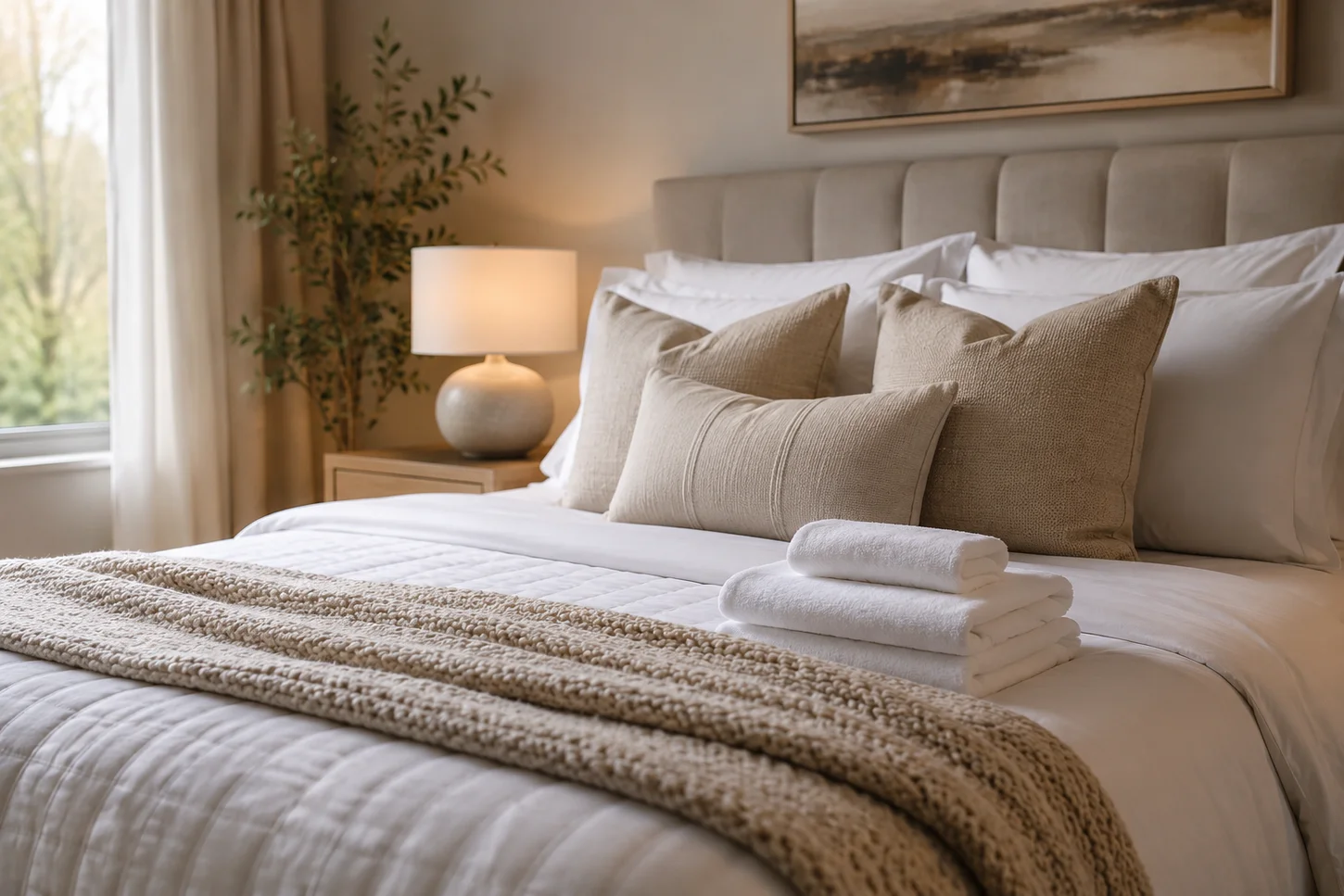
Guests may forget which streaming service was logged in or where you keep the spare keys, but they rarely forget an uncomfortable bed. The moment a guest sinks into a mattress and pulls up the sheets, they form an impression that shapes the rest of their stay—and very likely, the review they leave behind.
Bedding is one of the most impactful investments an Airbnb host can make. It is not simply about aesthetics. The best bedding for Airbnb hosts needs to balance guest comfort, durability, ease of cleaning, appearance, and the reality of frequent replacement. What works in your own bedroom—where sheets are washed occasionally and used gently—does not hold up in a high-turnover short-term rental where the same set may go through a commercial wash cycle every two to three days.
Airbnb identifies bedding and pillows as essential guest amenities. That designation matters because guests arrive with expectations. They are not staying in a budget motel; they have chosen your property over hotels, often at a comparable price point. The bed you put in front of them needs to deliver.
This guide covers everything a host needs to know: which materials hold up best, what thread count actually means, whether to use white or colored bedding, how many sets to stock, how to wash and maintain everything, how to make the bed look like it belongs in a boutique hotel, and how much to spend at each budget level. Whether you are setting up your first listing or refining an existing one, this is your complete reference for vacation rental bedding.
Why Bedding Matters for Airbnb Hosts
How Bedding Affects Guest Comfort and Reviews
Review scores are driven by sleep quality more than most hosts realize. When a guest leaves a comment about a “comfortable, clean space” or a “cozy bed,” they are often describing the combined effect of a supportive mattress, soft sheets, and pillows that actually suited them. When the opposite happens—scratchy sheets, flat pillows, a duvet that smells stale—those details find their way into reviews, too.
Short-term rental bedding takes significantly more wear than home bedding. In a busy listing, sheets may be washed 15 to 20 times per month. Pillows absorb repeated use without the long breaks personal bedding gets. Comforters face spills, pet hair, and guests who run the room’s air conditioning on full blast even in winter. The difference between good bedding and cheap bedding shows up in reviews—and in the replacement cycle that eats into margins.
Why Clean, Comfortable Bedding Creates a Better First Impression
The bed is usually the focal point of a bedroom. It is the first thing a guest sees when they push open the door. A neatly made bed with crisp, hotel-quality linens signals that the host cares about the property and about the guest’s experience. A sagging comforter thrown over a wrinkled fitted sheet signals the opposite.
First impressions in vacation rentals are largely visual. Guests photograph the bedroom, share it on social media, and compare it mentally to the listing photos. Hospitality bedding that looks sharp and feels soft when touched closes that gap between what was promised and what was delivered—and that gap is where five-star reviews live.
What Airbnb Guests Expect From Their Bedding
Modern travelers have grown accustomed to hotel-quality bedding, and they bring those expectations to short-term rentals. At minimum, guests expect sheets that are clean, wrinkle-free, and soft to the touch. They expect pillows that have not been flattened by a hundred previous guests. They expect a top layer—duvet or comforter—that is clean, not pilling, and appropriate for the climate.
Guests staying in a property listed at a premium price point expect more: layered bedding, matching pillowcases, decorative pillow arrangements, and a bed that invites them in rather than making them wonder whether the sheets were changed.
Failing to meet these baseline expectations does not just lose you a five-star rating. It costs you repeat bookings.
What Bedding Does an Airbnb Host Need?
Understanding the full Airbnb bedding checklist before you spend a dollar prevents costly gaps. Here is every layer and component a complete bed setup requires.
Mattress
The mattress is the foundation of every other investment. A poor mattress cannot be saved by expensive sheets. For short-term rentals, look for a medium to medium-firm option that suits the broadest range of sleepers. Memory foam and hybrid mattresses with pocketed coils are popular for vacation rentals because they balance comfort with support. Prioritize mattresses with removable, washable covers and straightforward handling for setup across multiple properties.
Mattress Protector
A mattress protector is non-negotiable in any short-term rental. It guards against spills, sweat, allergens, and damage that would otherwise shorten the life of a mattress dramatically. In a high-turnover environment, mattresses are exposed to more use in a month than most personal mattresses see in a year. A waterproof, breathable protector preserves your investment and ensures guests are sleeping on a hygienic surface. It is also far cheaper to replace a protector than a mattress.
Fitted Sheets
The fitted sheet goes directly on the mattress and is what guests feel when they sleep. It takes the most abuse of any bedding layer—sweat, skin contact, and frequent washing. Deep-pocket fitted sheets are essential for vacation rentals because they stay in place across different mattress depths, including thicker mattresses with toppers. A sheet that pops off the corners in the middle of the night generates complaints.
Flat Sheets
Flat sheets serve as a middle layer between the guest and the comforter or duvet. They are standard in hospitality settings because they protect the duvet from body contact, reducing how often the duvet itself needs to be washed. Not all guests use a flat sheet, but providing one is expected in a well-appointed rental. White flat sheets are particularly practical because they respond well to oxygen bleach and enzyme detergents for routine sanitization, with chlorine bleach held in reserve for emergency stain removal.
Pillows and Pillowcases
Pillows are among the most frequently mentioned items in vacation rental reviews—both positively and negatively. Flat, lumpy pillows disappoint guests every time. Pillowcases should be changed between every guest and washed at a temperature that sanitizes without degrading the fabric. Pillow protectors underneath the pillowcase extend pillow life and maintain hygiene.
Comforters and Duvets
The top layer is what guests see first and feel when they crawl into bed. A comforter or duvet insert should be clean, well-filled, and appropriate for the season or climate. Down-alternative fills are increasingly preferred in short-term rentals because they are machine washable, hypoallergenic, and easier to maintain than natural down.
Duvet Covers
A duvet cover protects the duvet insert and makes the top layer easy to change between guests without having to wash the insert every time. This is one of the most practical investments in the Airbnb bedding setup. Duvet covers should be easy to launder, fade-resistant, and visually consistent with the room’s design.
Blankets and Throws
An additional blanket folded at the foot of the bed gives guests temperature flexibility without requiring a full duvet change. Throws also add a visual layer that makes the bed look styled rather than simply functional. In cooler climates or properties with variable temperatures, extra blankets are essential.
What Are the Best Materials for Airbnb Bedding?
Material choice is the single biggest factor in how well your Airbnb bedding holds up over time. Here is how the most common options compare for vacation rental use.
Cotton
Cotton remains the most practical and widely used material for short-term rental bedding. It is breathable, soft, durable, and handles repeated washing better than most alternatives. Long-staple cotton varieties—Egyptian and Pima—produce a silkier, more durable fabric, though they come at a higher price point. For most Airbnb hosts, standard 100% cotton offers the best balance of performance and cost.
Cotton Percale
Percale is a plain-weave cotton fabric with a crisp, matte finish. It breathes exceptionally well, which makes it a strong choice for warm-weather properties or listings in tropical climates. Percale sheets tend to feel cool against the skin and get softer with each wash. They are durable but can wrinkle more than other weaves, which means a bit more attention during laundering.
Cotton Sateen
Sateen has a silkier, slightly shiny surface that feels luxurious against the skin. It is woven differently from percale, which gives it a heavier drape and a softer hand feel. For hosts aiming for a more upscale look, sateen sheets photograph beautifully and feel premium to guests. The trade-off is that sateen can snag more easily and may require more care during washing.
Linen
Linen is having a moment in the vacation rental market, especially in coastal, rustic, and boutique-style properties. It is incredibly durable—linen becomes softer the more it is washed—and it is naturally temperature-regulating, keeping guests cool in summer and warm in cooler months. The main drawbacks are cost (quality linen is expensive) and the wrinkled aesthetic that some guests may read as “unmade.” If linen suits your brand and your guests expect a relaxed, artisanal feel, it is a legitimate option.
Bamboo and Lyocell
Bamboo-derived fabrics, including Tencel lyocell, are soft, moisture-wicking, and eco-friendly. They feel similar to high-thread-count cotton but with added breathability. These materials are increasingly popular among hosts who want to market their properties as sustainable. They hold up well to washing, though they typically require cooler wash temperatures than cotton.
Microfiber
Microfiber is the most affordable option and the easiest to care for. It is lightweight, dries quickly, and resists wrinkles. However, it does not breathe as well as natural fibers, which can cause guests who sleep hot to feel uncomfortable. For budget listings or lower-demand properties, microfiber is a practical choice. It also performs well in climates where high heat during laundering is not an option, since microfiber tolerates a range of temperatures.
Polyester Blends
Cotton-polyester blends offer a middle ground: more durable and wrinkle-resistant than pure cotton, more breathable than pure polyester. Many hospitality suppliers recommend 60/40 or 50/50 blends for high-turnover environments because they retain their shape and color over more wash cycles. For Airbnb hosts managing multiple properties or high booking volumes, blends are worth serious consideration.
What Is the Best Thread Count for Airbnb Sheets?
Thread count is one of the most misunderstood concepts in bedding. Marketing has turned it into a proxy for quality, but the relationship is more complicated than the number on the label suggests.
Does a Higher Thread Count Mean Better Sheets?
Not necessarily. Thread count measures how many threads are woven into a square inch of fabric, counting both vertical (warp) and horizontal (weft) threads. Marketing-driven thread counts inflate this number by counting individual plies rather than threads—so a sheet labeled 800 thread count may use two-ply yarn and actually have closer to 400 threads per square inch. Above a certain point, adding more threads creates a denser, heavier fabric that can actually feel less breathable.
What Thread Count Should Airbnb Hosts Look For?
For short-term rental use, a thread count between 200 and 400 is the practical sweet spot. Sheets in this range are soft enough to feel comfortable, durable enough to survive frequent washing, and priced at a point where replacement is manageable. Hotel-grade sheets commonly fall between 250 and 300 thread count, which is a useful benchmark for hosts aiming for that hospitality feel.
| Thread Count Range | Suitable For |
| 200–250 | Budget rentals, high-turnover properties |
| 250–400 | Most Airbnb properties; hotel-quality feel |
| 400–600 | Luxury rentals; softer feel but may require gentler care |
| 600+ | Often inflated count; rarely necessary for rental use |
Why Fabric Quality Matters More Than Thread Count
A 300-thread-count sheet made from long-staple Egyptian cotton will outperform a 600-thread-count sheet made from short-staple cotton every time—in softness, in durability, and in how it feels after 50 washes. When evaluating sheets for your rental, prioritize fiber quality and construction over the number on the label.
Should Airbnb Hosts Use White or Colored Bedding?
The choice between white and colored bedding is one of the most practical decisions a host faces, and it has real implications for operations.
Benefits of White Airbnb Bedding
White sheets are the industry standard in hospitality for a reason. Stains, discoloration from body contact, and yellowing from repeated washing can all be addressed with oxygen bleach or enzyme-based detergents—without reaching for chlorine bleach, which should be reserved for heavy staining or emergency sanitization only, since frequent chlorine bleach use actually degrades cotton fibers and can accelerate yellowing over time. White bedding also signals cleanliness to guests immediately. A freshly washed set of white sheets, crisp and bright, communicates hygiene better than any other color.
White sheets are also easier to manage across multiple properties or when buying replacements. You do not need to match a specific color run, and you can mix sets from different purchase dates without visual inconsistency.
Pros and Cons of Colored Sheets
Colored and patterned bedding can work well in properties with a strong design identity—a bohemian cabin, a coastal cottage, or a mid-century modern apartment where the bedding is part of the overall aesthetic. The challenge is that colors fade with repeated washing and bleaching, and once a set starts to look washed out, it ages the room fast. Stains are also harder to remove from colored fabrics without chemicals that damage the dye.
| White Bedding | Colored Bedding | |
| Cleaning | Oxygen bleach + enzyme wash for routine use; chlorine bleach for emergencies only | Very limited stain removal options |
| Replacement | Easy to match across sets | Dye batches vary; matching is harder |
| Guest perception | Signals cleanliness and hygiene | Adds personality; risk of looking faded |
| Colorfastness | N/A | Fades with commercial washing |
| Versatility | Works in any room style | Tied to a specific aesthetic |
Why Neutral Bedding Is a Safe Choice for Vacation Rentals
If white feels too clinical for a property’s aesthetic, soft neutrals—warm whites, light greys, and stone tones—offer the best of both worlds. They photograph well, hold up over repeated washing better than saturated colors, and still communicate cleanliness. For hosts managing a single property with a specific design identity, a neutral palette gives room for decorative pillows and throws to add character without committing the sheets to a color that will eventually need replacing.
How to Choose the Best Sheets for an Airbnb
Not all sheets that feel luxurious in a home setting are appropriate for vacation rental use. These are the criteria that matter most.
Prioritize Durability and Frequent Washing
The best sheets for vacation rentals are the ones still performing after 100 wash cycles. Look for tight, even weaves, high-quality stitching at the seams, and materials known for longevity. Read reviews from other hosts or hospitality buyers, not just personal use reviewers—their washing frequency is closer to yours.
Choose Breathable Materials
Guests notice when they sleep hot. A breathable sheet—percale, linen, or bamboo—allows air to circulate and prevents that clammy feeling that disrupts sleep. In warm climates, breathability is especially important. Even in cooler destinations, a breathable sheet layered under a duvet performs better than a synthetic sheet that traps heat.
Look for Deep-Pocket Fitted Sheets
A fitted sheet that slips off the corner is a guest experience failure. Properties with pillow-top mattresses, toppers, or thicker mattress profiles need deep-pocket or extra-deep-pocket fitted sheets (at least 15 to 21 inches). This is a small detail that eliminates a consistent complaint.
Consider Wrinkle and Shrink Resistance
Wrinkled sheets photograph badly and make even a freshly laundered bed look careless. Microfiber and polyester blends are naturally wrinkle-resistant. For cotton and linen sheets, a quick tumble in a warm dryer and immediate folding or placement on the bed reduces wrinkles significantly. Look for sheets labeled “wrinkle-resistant” or “easy care” if your laundry process does not include pressing.
Buy Sheets That Are Easy to Replace
Consistency across guest stays and across multiple properties matters operationally. When a set wears out, you want to be able to replace it with an identical item. Favor sheets from brands that maintain consistent stock, and buy in bulk when you find a product that works. A set that is discontinued after six months creates operational headaches.
How to Choose the Best Pillows for an Airbnb
Pillows are underrated in most bedding discussions, but guests notice them immediately. A pillow that does not suit a sleeper’s preference is felt for an entire night.
How Many Pillows Should an Airbnb Provide?
A general rule for vacation rental properties:
- Twin/single bed: 2 pillows minimum
- Full/double bed: 2–4 pillows
- Queen bed: 4 pillows (2 sleeping, 2 decorative or additional)
- King bed: 4–6 pillows
Providing two firm pillows and two softer ones on a queen or king bed accommodates different sleep preferences without requiring guests to ask. The additional decorative pillows should be easy to remove and set aside—guests should not have to excavate the bed before sleeping.
Soft vs. Medium vs. Firm Pillows
Different sleepers prefer different pillow firmness levels based on sleep position. Side sleepers generally prefer a firmer, higher-loft pillow; back sleepers often prefer medium loft; stomach sleepers typically prefer soft, low-loft pillows. Since you cannot know how a guest sleeps, offering a mix of soft and medium-firm options is a practical compromise.
Down vs. Down-Alternative Pillows
Natural down pillows are soft, breathable, and luxurious—but they present allergy concerns for some guests and require specialized cleaning. Down-alternative pillows filled with polyester fiberfill or gel fiber are hypoallergenic, machine washable, and easier to replace. For most Airbnb properties, high-quality down-alternative is the smarter choice: it delivers a comparable sleep experience with fewer operational complications.
Should Airbnb Hosts Provide Different Pillow Options?
If you are managing a property that caters to longer stays or a guest demographic that values comfort above other factors, keeping extra pillows in a closet—in sealed, labeled bags indicating the fill type—gives guests the option to customize without requiring you to predict preferences in advance.
Why Pillow Protectors Are Worth the Investment
A pillow protector sits between the pillow itself and the pillowcase. It creates a barrier against sweat, oils, allergens, and spills that would otherwise soak into the pillow fill and degrade the material over time. Pillow protectors cost a fraction of a replacement pillow and extend pillow life significantly. They are one of the highest-return, lowest-cost additions to any Airbnb bedding checklist.
How to Choose the Best Comforter or Duvet for an Airbnb
The top layer of the bed is the most visually dominant element and often the first thing a guest touches. Getting this right matters.
All-Season vs. Seasonal Bedding
Unless you are managing properties in an extreme climate, an all-season weight comforter or duvet handles most scenarios. It is heavy enough to feel substantial in cooler temperatures and not so heavy that it is unusable in summer when paired with air conditioning. Supplementing with a lightweight throw or blanket at the foot of the bed provides flexibility without requiring seasonal changeovers.
Down vs. Down-Alternative Comforters
Natural down is warm, lightweight, and breathable—but it cannot be washed at high temperatures, poses allergy risks, and is expensive to replace. Down-alternative fills (polyester fiberfill, gel fiber, or microfiber) are machine washable at higher temperatures, hypoallergenic, and much easier to manage operationally. Most hosts running active short-term rentals use down-alternative for exactly these reasons.
Lightweight vs. Heavy Comforters
| Weight | Best For |
| Lightweight (200–300 GSM) | Warm climates, summer rentals, AC-heavy properties |
| Mid-weight (300–400 GSM) | All-season use; most vacation rentals |
| Heavyweight (400+ GSM) | Cold climates, winter cabins, mountain properties |
Duvet Inserts vs. Traditional Comforters
A duvet insert paired with a removable duvet cover is operationally superior to a traditional comforter for most short-term rentals. The cover takes the brunt of guest contact and can be washed after every stay while the insert is laundered less frequently. Traditional comforters must be washed in full each time, which requires large-capacity machines and longer dry times. If your laundry setup handles commercial-scale washing without issue, a comforter with a cover overlay can work—but the duvet-plus-cover system is more efficient.
How Easy Is It to Wash and Replace?
Before buying any comforter or duvet insert, check the care label. If it requires dry cleaning or delicate handling, it does not belong in a short-term rental. Your top layer needs to be machine washable on a standard or commercial cycle and able to dry fully in a standard dryer. Also check the dimensions before purchasing: a duvet insert that does not fill its cover fully, or hangs unevenly, looks cheaper than it is.
Best Bedding for Different Types of Airbnb Properties
The right bedding setup is not one-size-fits-all. Property type, location, and guest expectations all influence the ideal choice.
Best Bedding for Luxury Airbnbs
Luxury short-term rentals demand hospitality-grade materials. Look for 400-thread-count long-staple cotton sheets in white or ivory, high-fill-power down-alternative duvets, European-sized pillows with crisp sateen pillowcases, and layered bedding with a throw blanket. The bed should feel like a boutique hotel—because that is what the nightly rate promises.
Best Bedding for Budget-Friendly Airbnbs
Budget does not have to mean uncomfortable. Mid-range microfiber or cotton-polyester blend sheets in white or a clean neutral tone, a down-alternative comforter with a duvet cover, and firm polyester fill pillows can create a clean, guest-ready bed at a manageable cost. Prioritize hygiene, cleanliness, and consistency over luxury materials.
Best Bedding for Vacation Cabins
Cabin rentals call for warmth and a sense of comfort and coziness. Choose heavier-weight duvets or comforters, flannel or brushed cotton sheets in winter, and textured throw blankets in warm, earthy tones. Guests expect to feel warm and settled—the bedding should reinforce that atmosphere.
Best Bedding for Beach Houses
Coastal properties benefit from lightweight, breathable materials. Linen or percale sheets in white or soft coastal hues, lightweight cotton duvets, and easy-dry materials that handle sand and salt-air humidity are strong choices. Quick drying is a practical requirement in beach environments where laundry turnaround is faster.
Best Bedding for Urban Airbnb Apartments
City apartments tend to attract business travelers and weekend visitors who expect a hotel equivalent. White, crisp, high-quality cotton sheets, a neatly presented duvet with a clean cover, and ample pillows meet these expectations. A minimal, well-executed bedding setup photographs well in small spaces and communicates professionalism.
Best Bedding for Pet-Friendly Airbnbs
Pet-friendly listings need bedding that handles fur, dander, and the occasional accident. Dark or mid-tone bedding in durable, tightly woven fabrics is easier to maintain than white or light neutrals when pets are involved—though white still launders best. Mattress protectors rated for liquid resistance are essential. Keep a lint roller in the room and consider a washable pet throw placed over the bed during the stay to protect your primary bedding.
How Many Sets of Bedding Should an Airbnb Host Have?
Knowing how much bedding to stock prevents last-minute scrambles during back-to-back bookings.
The Two-Set vs. Three-Set Rule
The practical minimum for a single-property host is two complete sets of bedding per bed. One set is on the bed while the other is being laundered. For busy properties with short turnaround times between guests, two sets may not be enough—one set could still be in the dryer when the next guest arrives.
A three-set system provides genuine operational buffer. One set is on the bed, one is clean and ready, and one can be in the wash. Three sets are the standard recommendation for hosts managing high-occupancy properties.
Why Backup Bedding Is Essential
Stains happen. Zipper failures on duvet covers happen. Guests arrive early. Equipment breaks down mid-cycle. A backup set of bedding is not a luxury—it is an operational necessity. The cost of a third set is far lower than the cost of a negative review that mentions unclean or incomplete bedding.
How to Organize Bedding for Multiple Airbnb Properties
For hosts managing more than one property, keeping sets labeled and organized by property and bed size prevents confusion during turnover. Waterproof bags, vacuum storage bags, or labeled linen closet shelves work well. If you are using a cleaning service, clear organization means they do not need to call you to confirm which sheets belong where—a small friction point that adds up across dozens of turnovers.
How to Choose Durable Bedding for Frequent Airbnb Turnovers
Durability is where the economics of short-term rental bedding diverge most from personal bedding decisions.
Look for Strong Seams and Quality Construction
The seams of a fitted sheet or duvet cover are the first places failure shows. Check that seams are double-stitched and that the elastic on fitted sheets is reinforced along the full perimeter rather than just at the corners. A sheet that holds together through 100 wash cycles is better value than one that costs half as much and falls apart at 30.
Consider Colorfastness and Shrink Resistance
White sheets that yellow after 10 washes, or colored linens that fade to a patchy grey, create replacement costs that negate any savings from the initial purchase. Look for colorfastness ratings, and pre-wash new sheets before putting them on the bed for the first time to assess shrinkage. Sheets that shrink past the deep-pocket threshold after one wash will not fit the mattress properly.
Choose Bedding That Can Handle Commercial-Style Laundry
Hosts with high booking volumes often wash bedding at temperatures and cycles that exceed normal household recommendations. While 60°C (140°F) is effective for thermal disinfection, washing pure cotton repeatedly at this temperature accelerates elastic degradation on fitted sheets and shortens overall fabric life. The practical approach is to use an enzyme or oxygen-based chemical sanitizer at lower temperatures (40–60°C) for regular turnover washes, reserving the higher heat cycle for cases involving illness, heavy soiling, or confirmed contamination. Cotton-polyester blends generally handle the full range of these conditions better than pure cotton. Check that all materials can handle regular tumble drying without degrading, and follow care labels as the baseline.
Calculate the Long-Term Cost of Your Bedding
The upfront price of a sheet set tells you very little. The relevant metric is cost per wash cycle, or more usefully, cost per guest stay. A $30 sheet set that lasts 50 washes costs $0.60 per wash. A $60 set that lasts 200 washes costs $0.30 per wash—and delivers a better guest experience throughout. Investing more upfront in durable bedding almost always reduces total cost over time.
How to Wash and Maintain Airbnb Bedding
Proper laundering is as important as the bedding itself. Clean, well-maintained sheets extend the life of your investment and protect guests.
Wash Bedding Between Every Guest
This is non-negotiable. Every piece of bedding that came into contact with a guest—sheets, pillowcases, duvet covers, mattress protectors—should be laundered before the next arrival. Pillow protectors should be washed at least every second or third guest and inspected between uses.
Follow the Manufacturer’s Care Instructions
Washing at temperatures higher than the fabric can handle degrades fibers faster and accelerates shrinkage and color loss. While 60°C achieves thermal disinfection, routinely washing cotton at that temperature also stresses elastic bands and shortens sheet life. For regular turnover cycles, a chemical sanitizer or enzyme detergent at 40–60°C strikes a better balance between hygiene and longevity—with higher temperatures reserved for heavier contamination. Delicate materials like bamboo, lyocell, and fine blends require cooler temperatures still. Know your materials and adjust accordingly.
How to Deal With Common Bedding Stains
| Stain Type | Treatment |
| Blood | Cold water soak immediately; enzyme cleaner before washing |
| Wine / food | Blot (do not rub); treat with liquid detergent or oxygen-based stain remover |
| Body oils / yellowing | Oxygen bleach or a presoak in baking soda and dish soap before washing |
| Makeup | Oil-based stain remover on a clean cloth, then launder |
| General soiling | Presoak in an enzyme detergent, then wash on a warm cycle |
Treating stains before washing dramatically improves removal rates. Never put a stained sheet into a dryer before the stain is out—heat sets stains permanently.
How to Prevent Bedding From Becoming Damaged
Keep pillow protectors and mattress protectors in good condition to reduce the amount of sweat and oil that reaches your sheets. Using a duvet cover protects the insert, which should only need washing every few weeks rather than after every guest. Fold and store bedding carefully—stuffing it into drawers or bags while slightly damp can create mildew. Rotate between sets so no single set receives disproportionate wear.
When Should Airbnb Bedding Be Replaced?
| Item | Typical Replacement Cycle |
| Sheets | Every 12–18 months (high-turnover properties) |
| Pillowcases | Every 12–18 months |
| Pillow protectors | Every 6–12 months |
| Pillows | Every 12–24 months |
| Duvet covers | Every 12–18 months |
| Duvet inserts | Every 2–3 years |
| Mattress protectors | Every 2–4 years (with proper care; replace sooner if membrane tears or liquid damage occurs) |
| Mattresses | Every 5–8 years |
These timelines assume high-occupancy use. Inspect items at each turnover and replace anything that shows visible wear, pilling, thinning, permanent staining, or loss of shape—regardless of how long it has been in service.
How to Make an Airbnb Bed Look More Luxurious
The difference between a bed that looks functional and one that looks five-star is almost entirely technique.
Use Layered Bedding
A well-made Airbnb bed is not just a comforter thrown over a sheet. Layer a fitted sheet, flat sheet, and duvet or comforter, with an additional folded throw or blanket at the foot. Layering adds visual depth, signals attention to detail, and gives guests temperature flexibility throughout the night.
Choose a Consistent Color Scheme
The bedding should feel intentional, not assembled from whatever was on sale. White or neutral sheets with a slightly warmer or cooler comforter, pillowcases that match or complement each other, and a throw in a coordinating tone create a cohesive look. Avoid mixing too many patterns or colors, which can look chaotic in listing photos.
Arrange Pillows Properly
The standard hotel-style arrangement—sleeping pillows upright against the headboard, decorative or additional pillows stacked or arranged in front—reads immediately as well-managed hospitality. Pillowcases should face inward (openings toward the center) so seams and openings are not visible from the front. Plump pillows before placing them; a flat pillow standing upright looks neglected even if it is clean.
Keep Sheets Crisp and Wrinkle-Free
Crisp sheets are a sign of care. Remove sheets from the dryer before they cool and place them directly on the bed while still slightly warm—this reduces wrinkles significantly without ironing. For cotton or linen sheets that wrinkle easily, a fabric spray and a quick smooth with the hand can eliminate most of the problem.
Don’t Overdo Decorative Pillows and Throws
Two or three well-chosen decorative pillows add style. Eight decorative pillows that guests have to clear off the bed before sleeping add frustration. The goal is a bed that looks inviting, not one that requires furniture removal before use. Keep decorative elements minimal, well-chosen, and easy for guests to move aside.
How Much Should Airbnb Hosts Spend on Bedding?
Bedding budgets vary widely based on property type, listing price, and the host’s operational philosophy. Here is a practical framework for each level.
Building a Budget Airbnb Bedding Setup
For budget properties or first-time hosts managing costs carefully, a functional setup can be built for approximately $100–$200 per bed. This includes:
- Microfiber or cotton-poly blend sheet set
- Down-alternative comforter in a basic duvet cover
- 2–4 polyester fill pillows with protectors
- Waterproof mattress protector
This setup will not win reviews for its luxuriousness, but it will be clean, functional, and presentable.
Building a Mid-Range Airbnb Bedding Setup
A mid-range setup—suitable for most Airbnb properties listed at average to slightly above-average rates—runs approximately $200–$400 per bed and might include:
- 300-thread-count cotton or cotton-blend sheet set in white
- Quality down-alternative duvet insert with a durable duvet cover
- Medium-firm down-alternative pillows with protectors
- Decorative throw or blanket
- Waterproof mattress protector
This range covers the majority of Airbnb listings and delivers genuine comfort at a cost that allows for regular replacement.
Building a Luxury Airbnb Bedding Setup
For premium or luxury short-term rentals where bedding is part of the brand promise, a per-bed investment of $400–$800+ is reasonable. Expect to spend on:
- Long-staple Egyptian or Pima cotton sheets (400+ TC) or high-quality linen
- High-fill-power down-alternative or responsible-down duvet insert
- Designer or premium brand duvet cover
- Multiple pillow types (soft, medium, firm) with premium covers
- Coordinating throws and decorative cushions
Where Airbnb Hosts Should Spend More Money
If you are going to allocate your budget strategically, spend more on pillows and sheets—the two items guests feel most directly. A cheap pillow ruins a night’s sleep. A rough or scratchy sheet is the first thing a guest notices when they get into bed. Mattress protectors are also worth the investment because they protect the most expensive item in the room.
Where Airbnb Hosts Can Save Money
Duvet inserts, throws, and decorative pillows are areas where mid-range options perform comparably to premium ones in terms of guest experience. Guests rarely touch a decorative cushion or examine the fill power of a duvet insert. Spend where it is felt; save where it is only seen.
Common Airbnb Bedding Mistakes to Avoid
Even experienced hosts make recurring mistakes that reduce guest satisfaction and increase long-term costs.
Choosing Bedding Based Only on Price
The cheapest sheet set you can find is rarely the cheapest option when you account for replacement frequency. Bedding that wears out in three months costs more annually than bedding that lasts two years, even at a higher upfront price. Build a cost-per-stay calculation before buying.
Prioritizing Appearance Over Comfort
A beautiful bed that is uncomfortable is a failed investment. A silky-looking sateen set that sleeps hot, or an elegant linen arrangement that feels scratchy, will generate negative feedback regardless of how good it looks in photos. Comfort must come first.
Buying Low-Quality Pillows
This is the most common bedding mistake in short-term rentals. Flat, thin, or lumpy pillows generate specific complaints in reviews. A good pillow costs between $20 and $60 and dramatically outperforms the $5 options. The difference in guest experience is disproportionate to the cost difference.
Skipping Mattress Protectors
A mattress without a protector is one spill away from an expensive replacement. There is no logical case for skipping this item. It is cheap, it is easy to launder, and it prevents thousands of dollars in mattress damage.
Not Keeping Backup Bedding
Running a single set per bed is a liability. If laundry equipment fails, if a guest damages a set, or if a stain cannot be removed in time for the next check-in, you are out of options. The cost of a spare set is small compared to the cost of a cancellation or a negative review.
Buying Bedding That Is Difficult to Launder
Dry-clean-only materials, hand-wash-only duvets, and delicate fabrics that must be washed at low temperatures do not belong in a short-term rental. If it cannot go through a standard or commercial cycle and come out ready to use, choose something else.
Ignoring Seasonal Guest Comfort
A single heavy duvet is not appropriate for a property that operates year-round in a climate with warm summers. Providing a lighter layer in summer months—or leaving an extra blanket accessible in the closet—prevents the common complaint of guests who were too hot to sleep. Match your bedding weight to your booking season.
What Is the Best Bedding Setup for an Airbnb?
Here is a consolidated overview of the ideal complete setup for a typical mid-range Airbnb property.
The Ideal Airbnb Mattress Setup
- Quality medium-firm mattress (hybrid or memory foam)
- Waterproof, breathable mattress protector
The Ideal Airbnb Sheet Setup
- White, 300-thread-count, 100% cotton fitted sheet (deep pocket)
- White flat sheet in matching material
- 2–3 full sets of the above per bed
The Ideal Airbnb Pillow Setup
- 2 firm pillows and 2 medium pillows per queen bed
- Quality pillow protectors on each pillow
- Washable, hypoallergenic down-alternative fill
The Ideal Comforter and Duvet Setup
- All-season down-alternative duvet insert (350–400 GSM)
- White or neutral duvet cover that matches the sheet set
- Lightweight throw or blanket folded at the foot of the bed
The Complete Five-Star Airbnb Bed
A complete five-star Airbnb bed layers all of the above: fitted sheet, flat sheet, duvet with cover, sleeping pillows upright at the headboard, additional pillows in front, and a folded throw at the foot. The sheets are crisp and wrinkle-free. The pillowcases face inward. The duvet is smooth and centered with even overhang on both sides. The throw is folded deliberately, not dropped. It is a bed that looks like someone took the time to make it well—because they did.
How Bedding Fits Into the Airbnb Guest Experience
A Comfortable Bed Is Only Part of a Great Stay
A great night’s sleep is the foundation of a positive guest experience, but it is not the whole picture. Guests also need to know how to use the property, where to find what they need, and how to navigate the local area. When these elements work together, the experience feels seamless. When they do not, even a perfectly made bed cannot salvage a confusing check-in or a property where the Wi-Fi password is buried in a week-old email.
Give Guests Easy Access to Property Information
Guests should not have to search for essential information. The best hosts make property details—Wi-Fi credentials, appliance instructions, house rules, emergency contacts—immediately accessible without requiring a phone call. Airbnb guest guidebooks have become a popular way to consolidate this information, but their effectiveness depends entirely on how easily guests can access them.
Make Check-In and Check-Out Easier
A smooth check-in is the first real interaction a guest has with your property after the photos and the listing. Check-out, handled well, leaves a final positive impression before a guest writes their review. Clear, step-by-step instructions for both processes reduce confusion, reduce calls and messages to the host, and reduce the chance that a guest leaves feeling uncertain or frustrated.
Provide Local Recommendations and Helpful Instructions
Guests who feel connected to a destination—who ate at the restaurant you recommended, who found the trail you mentioned—leave more positive reviews and are more likely to return. Local recommendations used to mean a handwritten notepad in the kitchen. Today’s guests expect more: organized, curated guidance that is easy to browse and updated regularly.
Use GuideScreen to Improve the Guest Experience
A well-dressed bed sets a tone. A well-informed guest completes the experience. GuideScreen’s wall-mounted digital concierge sits in your property and gives guests a dedicated screen for everything from welcome messages personalized with their name to Wi-Fi QR codes, property instructions, checkout checklists, and local recommendations—all without requiring guests to open an app or search through messages.
For hosts who are investing in their properties—updating the mattress, stocking three sets of quality sheets, choosing bedding that reflects the standard of the listing—GuideScreen is a natural extension of that same philosophy. Explore the full feature set to see how it fits into your hosting setup.
How to Build an Airbnb Bedding Checklist
A structured checklist prevents gaps during setup and turnover. Use this as a starting reference for each bed in your property.
Per Bed – Before First Guest Arrival
- [ ] Quality mattress installed
- [ ] Waterproof mattress protector fitted and secured
- [ ] Fitted sheet applied (deep pocket; pre-washed for shrinkage)
- [ ] Flat sheet positioned
- [ ] Pillows (minimum 2 per single/twin; 4 per queen/king)
- [ ] Pillow protectors on all pillows
- [ ] Pillowcases on all sleeping pillows
- [ ] Duvet insert inside cover, properly aligned
- [ ] Decorative or additional pillows arranged
- [ ] Throw or blanket folded at foot of bed
- [ ] Backup set (complete) stored in linen closet
Between Each Guest
- [ ] All used sheets, pillowcases, and duvet covers removed
- [ ] Pillow protectors inspected and washed if needed
- [ ] Mattress protector laundered if any contact or staining
- [ ] All items washed at appropriate temperature
- [ ] Fresh set applied before next check-in
- [ ] Stains treated before washing (never dried in)
Frequently Asked Questions About Airbnb Bedding
What Is the Best Type of Bedding for an Airbnb?
The best Airbnb bedding is 100% cotton or a cotton-polyester blend in white or a soft neutral tone. These materials are durable, easy to clean at high temperatures, and comfortable for a wide range of guests. For a more luxurious feel, long-staple cotton (Egyptian or Pima) is worth the investment in premium listings.
What Sheets Are Best for Airbnb Hosts?
The best sheets for Airbnb hosts are 100% cotton percale or a quality cotton-polyester blend in white, with a thread count between 250 and 400. They should be deep-pocket fitted sheets, pre-shrunk, and rated for washing at sanitizing temperatures.
What Thread Count Is Best for Airbnb Sheets?
A thread count between 200 and 400 is the practical target for most vacation rentals. Hotel-grade sheets typically fall in the 250–300 range. Thread count above 400 rarely improves the guest experience in proportion to the added cost.
Are White Sheets Better for Airbnb?
Yes, for most properties. White sheets handle stain removal and sanitization more effectively than colored alternatives—oxygen bleach and enzyme detergents work on white cotton without damaging the dye, and chlorine bleach can be used sparingly for heavy staining (though frequent use degrades fibers over time). White sheets also signal cleanliness to guests, are easy to replace consistently, and photograph well. Soft neutrals are a suitable alternative if the property’s aesthetic warrants it.
How Many Sets of Sheets Should an Airbnb Host Have?
A minimum of two complete sets per bed; three sets are recommended for high-occupancy properties. One set is on the bed, one is clean and ready, and one can be in the wash.
How Often Should Airbnb Bedding Be Replaced?
Sheets and pillowcases typically need replacing every 12 to 18 months under high-turnover use. Pillows last 12 to 24 months. Duvet inserts generally last two to three years. Replace any item sooner if it shows visible wear, permanent staining, or loss of structural integrity.
Should Airbnb Hosts Use Mattress Protectors?
Always. A waterproof mattress protector is one of the most cost-effective purchases a host can make. It protects a significant investment, maintains hygiene between guests, and is simple to launder.
How Many Pillows Should an Airbnb Have?
A minimum of two pillows per person the bed is rated to sleep is a good starting point. A queen bed should have at least four pillows: two for sleeping and two additional. Providing a mix of firmness levels accommodates different sleep preferences.
Is Microfiber Good for Airbnb Bedding?
Microfiber is a practical choice for budget properties or as a secondary set. It is wrinkle-resistant, dries quickly, and is easy to maintain. The main drawback is breathability—guests who sleep hot may find microfiber sheets uncomfortable. For most listings, cotton or a cotton blend outperforms microfiber in overall guest satisfaction.
Is Linen Good for Airbnb Bedding?
Linen works well in the right property context—coastal, rustic, or boutique-style rentals where the relaxed, organic aesthetic fits the brand. It is highly durable and gets softer with each wash. The cost is higher than cotton, and the wrinkled appearance may not suit all guests or properties. For mainstream Airbnb listings, cotton remains the more practical choice.
How Do You Make an Airbnb Bed Feel Like a Hotel?
Use white or near-white cotton sheets with a thread count in the 300 range, a well-filled duvet with a crisp duvet cover, and quality pillows at multiple firmness levels. Layer the bedding, arrange pillows neatly, and make sure the sheets are smooth and wrinkle-free before photography and guest arrival. A mattress topper can add that extra depth of comfort that distinguishes a hotel-style sleep experience from an average rental bed.
From a Well-Made Bed to a Seamlessly Run Property
A properly stocked, well-maintained bed tells guests that the host sweats the details. That same attention to detail extends to every other element of the guest experience—and the hosts who understand that are the ones with the most consistent five-star reviews.
Bedding is where guests sleep. The rest of the property is where they live during their stay. When a guest wakes up rested, finds the coffee instructions on the wall, knows exactly how to check out, and leaves having visited the café you recommended around the corner—that is not an accident. That is the result of a host who thought about the whole experience, not just individual pieces of it.
A digital concierge for vacation rentals like GuideScreen handles the information layer of that experience—the check-in steps, the local picks, the property instructions—so the same care you put into choosing the right sheets extends to every moment of the guest’s stay. A comfortable bed and a well-informed guest are not separate goals. They are the same goal, approached from different directions.