
Why Most Digital Guidebooks Fail (And How to Fix It)
- Mobile guidebooks go unused because guests arrive juggling luggage and logistics, not scrolling through links buried in their phones
- Arrival is the critical moment — the first five minutes shape the entire stay, yet this is when guests are least likely to read instructions
- Visibility is everything — information must be immediately accessible without requiring guests to search for it
- Wall-mounted digital concierges solve this gap by providing always-visible, interactive information exactly when and where guests need it
- A hybrid approach works best — mobile before arrival, in-home screens during the stay
A digital guidebook is how we share essential information with guests — Wi-Fi details, house instructions, local recommendations, and everything they need to feel at home. It’s the modern evolution of those thick paper binders that used to sit on coffee tables, now reimagined for travelers who expect clarity and convenience.
We’ve watched hundreds of guests arrive at properties over the years, and one pattern is impossible to ignore: even with the best intentions to go paperless, information still gets lost. Physical binders disappear under magazines. Mobile guidebooks vanish into message threads. And when guests need answers most, the information is nowhere in sight.
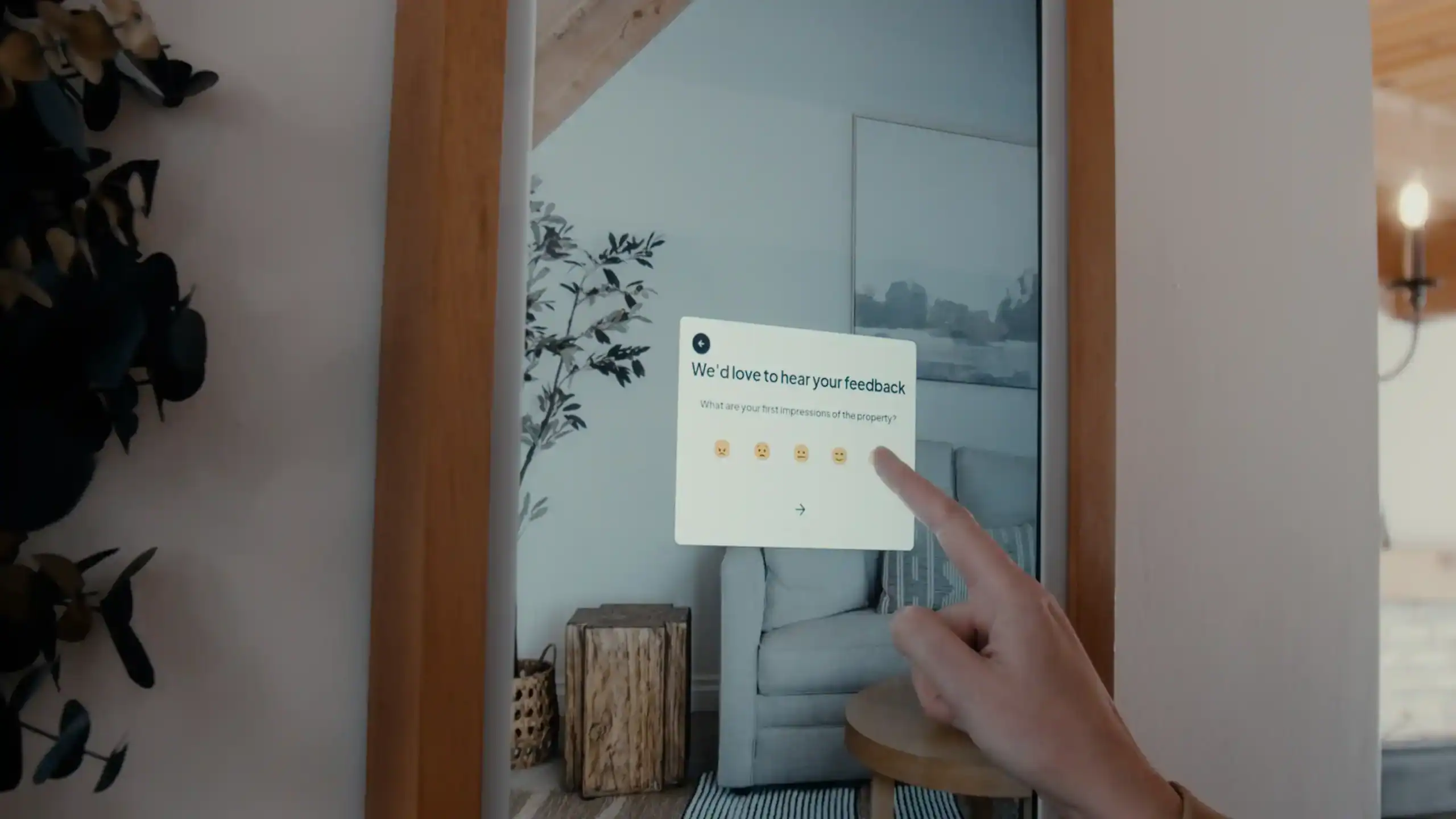
What’s emerging as a solution — and what we’re seeing thoughtful hosts adopt — is the wall-mounted digital concierge. These screens blend the permanence of a physical object with the flexibility of digital content. Positioned where guests naturally look when they walk in, they greet visitors, display essentials, and offer local insights without requiring guests to remember a link or dig through notifications.
In this article, we’re sharing what we’ve learned about building digital guidebooks that guests actually use. We’ll explore design principles, guest behavior patterns, and technology choices that turn guidebooks from overlooked resources into essential parts of a memorable stay.
The First Five Minutes: Why Arrival Sets the Tone
If you’ve ever watched guests arrive at a property, you know the moment well. They’re not just carrying suitcases — they’re juggling conversations, decompressing from travel, and trying to orient themselves in a new space. We’ve observed this hundreds of times, and one thing is consistent: guests rarely arrive in instruction-reading mode.
Within minutes, the same questions surface:
- “What’s the Wi-Fi again?”
- “How do we adjust the temperature?”
- “Does anyone know how to work the TV?”
- “Where should we put our bags?”
This is where mobile guidebooks fall short. Even beautifully designed apps remain hidden on phones, requiring guests to remember they exist, find them, and read them — all while trying to settle in.
A visible guidebook presence changes everything. When mounted on a wall in an entryway or common area, it naturally draws attention and offers immediate answers without interrupting the arrival flow.
“After hosting hundreds of guests, we realized the biggest challenge isn’t creating information — it’s making sure people actually see it when they need it most.” — Experienced Property Manager
Why Design-Forward Hosts Love Wall-Mounted Screens
In-home digital guidebooks transform check-in into something intentional and curated — more boutique hotel than typical rental. They replace the clutter of binders, sticky notes, and countertop tablets that disrupt the aesthetic you’ve worked hard to create.
The screen becomes part of your design language: a clean, modern element that elevates the space. Guests notice. They perceive the property as more professionally managed and thoughtfully designed — small details that translate into better reviews and repeat stays.
The Limitations of Mobile Guidebooks
We’ve all experienced it: you send a beautifully crafted mobile guidebook, and guests still ask the very questions you answered. Why?
Mobile works before arrival — not during it
Mobile guidebooks are great for:
- directions
- access instructions
- local recommendations
- policies
- contact info
But once guests arrive, convenience shifts. What’s easy for us isn’t always easy for them.
Why guests don’t read what we send
After observing countless check-ins, we’ve noticed consistent patterns:
- Digital overload: Travel days are filled with notifications and apps. Your guidebook becomes just another message.
- The three-day memory gap: Anything sent days before arrival is buried under newer messages.
- Arrival mindset: Guests want to relax, not read instructions on a small screen.
- Group dynamics: When multiple people arrive together, they focus on each other, not their phones.
“We used to get frustrated when guests asked questions we’d already answered. Then we realized: if they’re not reading it, that’s on us, not them.” — Property Manager
QR codes and apps still require effort
We’ve watched guests walk right past QR codes without noticing them. Anything that requires effort at arrival — scanning, tapping, loading — is unlikely to be used.
The real issue: mobile doesn’t meet guests where they are
Mobile shines before arrival.
But once guests step inside, they need answers in the space, not in their phones.
A physical, always-visible guidebook bridges this gap.
Understanding Guest Behavior: In-Home Screens vs. Smartphones
The Buried Link Phenomenon
We’ve seen this play out countless times:
“Did you get the guidebook link?”
“Oh, yes… I think so…”
scrolls through messages for 30 seconds
If information isn’t visible at arrival, it might as well not exist.
Phones are crowded spaces — work emails, social media, family messages. Your guidebook competes with all of it.
Why a dedicated in-home screen changes everything
Here’s what we’ve observed:
- It’s simply there — no searching or remembering
- It belongs to the space — not to any one guest
- It invites spontaneous use — guests naturally interact with it
Meeting the needs of all guests
We’ve hosted:
- elderly travelers who struggle with apps
- international guests with limited data
- families where only one person has the booking info
A shared device solves all of this.
The psychology behind better adoption
Physical presence changes behavior:
- We naturally look at screens in our environment
- Contextual information feels more relevant
- Shared devices create shared experiences
“Our guests used to text us the same questions over and over. With the wall-mounted guide, they just look up and find what they need.” — Property Manager
Wall-Mounted Digital Concierges: Bridging the Gap
In-home digital guidebooks don’t replace mobile — they complete it. They bring your digital guidebook out of hiding and into the physical world where guests actually need it.
The power of being seen
- Guests see the screen the moment they walk in
- Information appears exactly when questions arise
- Every guest has equal access
Intuitive design for everyone
We love these devices because:
- touchscreens are familiar
- no downloads or passwords
- PMS integration enables personalized welcomes
Accessible for all types of guests
- grandparents easily check restaurant recs
- kids explore local attractions
- international guests rely on visual guides
- groups gather around one shared source
Removing barriers to information
No links.
No searching.
No friction.
Just answers.
Core Features That Make In-Home Guidebooks Effective
1. Essential content presented visually
The best screens include:
- check-in steps
- Wi-Fi details
- house instructions
- curated local spots
- short how-to videos
We’ve found that a 30-second video tutorial can eliminate entire categories of guest questions.
2. Personalization that feels thoughtful
“Seeing ‘Welcome, Jennifer!’ made me feel expected and taken care of.” — Guest
Personalization turns a rental into a hosted experience.
3. Real-time communication that prevents problems
Screens can:
- prompt guests for quick feedback
- surface issues early
- notify you instantly
This protects your reviews and improves the stay.
How to Build a Guidebook Guests Actually Use
Here’s what we’ve learned works best:
- Put essentials where eyes naturally land
- Think like a first-time visitor
- Show, don’t tell
- Design for all types of guests
- Keep information consistent everywhere
- Make it interactive
- Choose hardware that enhances your space
- Organize content by guest journey
- Test with fresh eyes
- Make emergency info unmissable
- Keep content fresh
- Measure what’s working
Following these principles turns a guidebook into a true guest resource.
How In-Home Guidebooks Transform Hosting
Hosts consistently report:
- fewer repetitive questions
- smoother check-ins
- better reviews
- more professional presentation
- more time for meaningful interactions
- easier scaling across multiple properties
“We make one update and all our screens update automatically. It’s given us our weekends back.” — Multi-Unit Host
Creating a Seamless Information Experience
The most successful approach isn’t choosing between mobile and in-home — it’s using both thoughtfully.
Mobile shines before arrival
Planning, directions, expectations.
In-home screens excel during the stay
Orientation, appliance use, shared reference.
Consistency is key
Same details, same language, adapted to each medium.
Meet guests where they are
Context matters.
“Guests love having info on their phones before arrival, but the wall screen is what they actually use during their stay.” — Host
Why Wall-Mounted Screens Aren’t Just Tablets
We’ve seen tablets end up:
- under magazines
- unplugged on nightstands
- dead by the time guests need them
Wall-mounted screens solve this through:
- permanence
- visibility
- durability
- design integration
- hospitality-specific features
They’re built for shared spaces, not personal use.
The Evolution of Guest Information
We’ve moved from binders → PDFs → mobile → in-home screens.
Why?
Because visibility matters.
We’ve seen guests arrive and ask the same three questions every time, no matter how detailed the pre-arrival message was. If information isn’t visible, guests won’t go looking for it.
Wall-mounted screens solve this by being present, accessible, and impossible to overlook.
Conclusion: The Future Is Visible, Design-Forward, and Guest-Centered
The future of guest communication isn’t about adding more technology — it’s about placing the right information in the right place at the right moment.
Mobile guidebooks prepare guests before they arrive.
In-home digital concierges guide them once they’re inside.
Together, they create a seamless, intuitive experience that reduces friction and elevates hospitality.
For hosts who want a physical, design-forward, always-visible guidebook experience, wall-mounted screens represent the natural next step. They meet guests where they are, anticipate their needs, and turn information into part of the space — not something hidden in a phone.
This is the evolution of the digital guidebook.
And it’s already becoming the new standard.